

Anti-poaching drone: night cover over the whole reserve, from one launch
Last updated: 18 November 2026
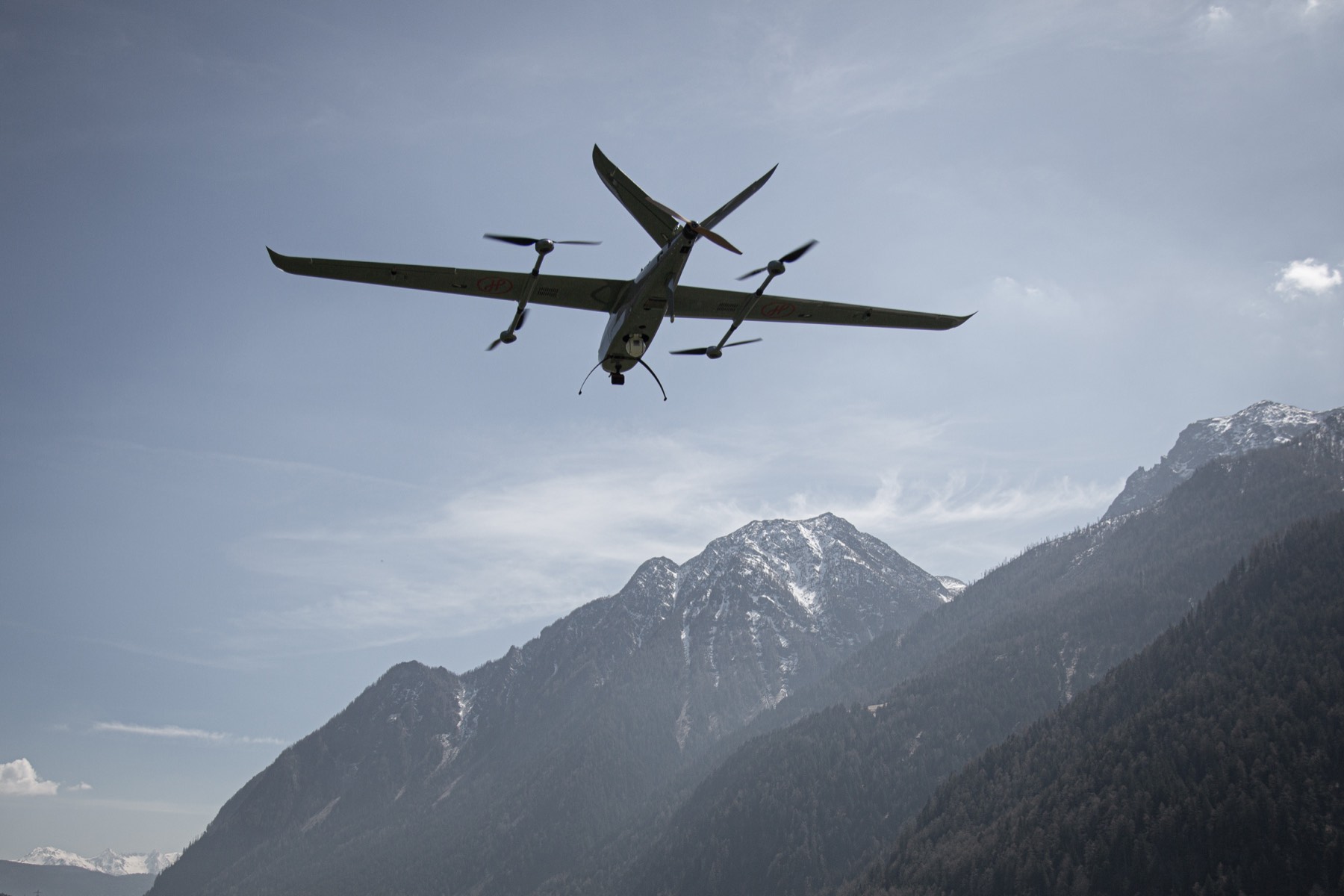
Reserves are large and ranger teams are small. Jabali is a fixed-wing VTOL anti-poaching drone that launches vertically from inside the reserve, with no airstrip and no catapult, then flies a boundary or sector patrol for hours with thermal and EO/IR payloads that pick out people and vehicles in the dark.
Every system is supplied and integrated by Helvetis, a Swiss drone company, and configured around the reserve and the team that will fly it, not sold as a fixed product.
Capabilities
01
Whole-boundary patrols
Wing-borne endurance keeps one aircraft over the reserve for hours from a single vertical launch, so a patrol covers the boundary and the sectors behind it instead of the one road a vehicle could reach that night.
02
Night detection of people and vehicles
Thermal imaging reads body heat and warm engines against cool ground after dark, and stabilised EO/IR with optical zoom confirms what the thermal sensor found. Darkness is when most incursions happen.
03
Launch from inside the reserve
Vertical take-off needs no airstrip, no catapult and no ground crew, so the aircraft flies from the ranger post, a firebreak or a clearing rather than being trucked to the nearest runway.
04
Evidence rangers can hand on
Detections and imagery are georeferenced and time-stamped, so a sighting becomes a position a team can be sent to and a record that can be passed to the authority handling the case.
The reserve is large and the ranger team is small
Anti-poaching is a coverage problem before it is a technology problem. A conservancy or national park runs to hundreds or thousands of square kilometres, with a boundary measured in tens or hundreds of kilometres, and a team that can put a handful of vehicles out on any given night. A ranger patrol covers the sector it can drive, and it announces itself: engine noise and headlights carry for kilometres across open country, so anyone who does not want to be seen simply moves. Meanwhile the activity that matters concentrates in darkness, which is exactly when a patrol on the ground sees least.
Aircraft close that gap, but the usual options do not fit a reserve. A helicopter covers ground and is heard doing it, and few conservancies can fund the flying hours. A multirotor drone launches anywhere but runs out of battery long before a boundary is covered. A conventional fixed-wing aircraft has the endurance and needs a runway the reserve does not have. A fixed-wing VTOL drone takes the useful half of each: it lifts off vertically from the ranger post, then flies on the wing for hours. That is the shape of a practical conservation drone.
What that buys per sortie is worth stating plainly. The hybrid platform carries an indicative range of up to 850 km and up to 10 hours aloft, at a cruise of roughly 65 to 85 km/h. Flown along a boundary, that is a fence line most teams could not walk in a week, covered several times in one night. Flown as a search pattern over a sector, the area covered depends on the sensor, the altitude and the overlap between passes, so it is worked out with you during configuration rather than quoted as a headline hectare figure that would not survive contact with your terrain.
Why the aircraft launches from inside the reserve
This is the part that decides whether a system gets used. Vertical take-off and landing means no airstrip, no catapult, no launch rail and no recovery net. The aircraft goes up from a ranger post, a firebreak, a clearing or a track, and comes back down on the same spot. Nothing has to be graded, nothing has to be trucked, and a team of two can put it in the air.
The practical difference is time and reach. A platform that needs a runway is flown from wherever the runway is, which in most reserves means a long transit at each end of the sortie, burning the endurance that was the reason for buying it. Launching inside the boundary puts the whole flight over the ground you are protecting, and it means a patrol can be flown on the night it is needed rather than the day it can be arranged.
Recovery is the other half of the argument. A conventional fixed-wing aircraft comes back by net, belly landing or parachute, all of which need clear ground and all of which are hard on a payload that costs more than the airframe. A precise vertical landing puts the aircraft back where it started, so the same two people can change a battery and fly the next sector.
One more thing decides whether a patrol is worth flying: whether the aircraft announces itself the way a vehicle does. The electric platforms, Jabali E and EX, run on battery-driven motors with no combustion engine, so the only sound they make is propeller noise, and it falls away quickly with altitude and distance. With no exhaust plume and no hot engine block, they also present a far smaller infrared signature than a fuel-burning aircraft. It means less disturbance to the animals underneath as well, which matters over a reserve. The hybrid Jabali X trades some of that quietness for its long endurance, and that is the choice to weigh when the sortie has to last. What is actually audible from the ground depends on altitude, terrain and background noise, and it is worked through with you when the platform is chosen.
Dust, heat, and who services it in the field
A system that cannot be maintained at the reserve is a system that spends the season in a crate. Jabali is built for field conditions: IP54 ingress protection, an operating range of -10 to 60 °C, a waterproof airspeed sensor (heated on the EX and X), and wind resistance of up to 13 m/s on every platform, which matters in open country where the afternoon wind is the usual reason a patrol does not fly.
Servicing is designed around the people who will actually do it. Every system is handed over with operator and maintainer training, documentation and a spares package, so the unit can rig, launch, recover and maintain the aircraft without waiting on a visit from Europe. Helvetis supports the capability across its life, including remote support, spares and upgrades.
Evidence handling is the last practical question, and the answer is deliberately dull. Video and detections are recorded with a position and a time, so an incursion produces a georeferenced track rather than an anecdote. What is shared, with whom and for how long is set by the conservancy or authority that owns the operation, and the system is configured to fit that, including where the data is held. Any AI detection assists the operator: a person confirms every detection and decides what happens next, which keeps the record defensible if it is ever used in a prosecution.
On proof, we would rather point at what can be checked. Helvetis has flown tens of thousands of flights onshore and offshore, pioneered offshore drone inspection in 2013, and operates worldwide, from high-altitude Alpine work to the harsh North Sea and African deserts. Where a conservancy is willing to act as a reference, we introduce you to them directly rather than describing their operation ourselves.
Thermal and EO/IR: finding people in the dark
Anti-poaching flying is mostly night flying, so the thermal sensor is the payload that decides whether the sortie was worth flying. Thermal imaging reads the temperature difference between a body and the ground it is standing on, which is at its largest in the hours after sunset in dry country. A person walking a fence line, a group at a treeline, a vehicle parked with a warm engine: each reads as a bright shape against cool ground, with or without moonlight.

Thermal finds, optics identify. Stabilised EO/IR with optical zoom lets the operator hold the contact and look closer, so a detection can be resolved into people, a vehicle or livestock before a team is committed. That distinction is most of the value of the flight: sending rangers to every heat signature exhausts them, and sending them to none defeats the point of flying.
Optional AI video analytics can flag possible people and vehicles in the live feed and raise configurable alerts, which keeps an operator effective through a long night watch. It assists, it does not decide. The operator confirms every detection, and live video reaches the control room over radio, cellular or satellite links, including Starlink-compatible connectivity, so a reserve with no cellular coverage is not a reserve without a picture.
Configured for the reserve
Endurance, thermal payload and connectivity are matched to the size of the reserve and the way your team works, whether the task is anti-poaching patrol or wider wildlife monitoring.
- Endurance
- 3 to 10 h
- Range
- 245 to 850 km
- Payload
- 4 to 10 kg
Final figures confirmed at configuration.
Jabali platform variants


|
Jabali E
Electric
Portable · routine missions |
Jabali EX
Electric
Heavy payload · extended reach |
Jabali X
Hybrid fuel
Long endurance · wide area |
|---|---|---|
| 210 | 240 | 600 |
| 245 | 280 | 850 |
| 4 | 10 | 8 |
| 3.4 | 3.9 | 4.0 |
| 70 | 72 | 85 |
| 110 | 130 | 130 |
| 16 | 28 | 30 |
| 20 | 38 | 45 |
| 3500 | 4500 | 3000 |
| 13 | 13 | 13 |
| -10 to 60 | -10 to 60 | -10 to 60 |
| IP54 | IP54 | IP54 |
| Waterproof | Heated, waterproof | Heated, waterproof |
| 3378 × 1500 × 500 | 3914 × 1937 × 712 | 4000 × 2056 × 767 |
Final specifications depend on payload, conditions and configuration.
Questions
Anti-poaching drones fly boundary and sector patrols over a reserve, mostly at night, using thermal imaging to detect people and vehicles and optical zoom to identify them.
Detections are georeferenced, so a ranger team can be sent to a position rather than a description. A fixed-wing VTOL drone like Jabali adds hours of endurance while still launching vertically from inside the reserve, with no airstrip.
Thermal imaging is what makes night patrols work: it reads body heat and warm engines against cooler ground, so a person or a vehicle shows up without any light at all.
Stabilised EO/IR with optical zoom then confirms the contact before anyone is sent to it. Detection range depends on the payload, altitude, terrain and weather, and is confirmed for your configuration.
Indicative range across the family runs up to 850 km with up to 10 hours aloft, at a cruise of roughly 65 to 85 km/h.
Flown along a boundary, one sortie can cover a fence line several times over in a night. Flown as a search pattern, the area depends on the sensor, altitude and overlap between passes, so coverage is worked out for your reserve during configuration.
No.
The aircraft takes off and lands vertically, so it flies from a ranger post, a firebreak, a clearing or a track inside the reserve, with no airstrip, catapult, launch rail or recovery net. Two people can launch it, and it returns to a precise vertical landing on the same spot to change a battery and fly the next sector.
Yes, and that is the intent.
Every system is delivered with operator and maintainer training, documentation and a spares package, combining classroom, practical and simulator work, so the unit can plan, fly, recover and service the aircraft independently. Helvetis supports the capability across its life with remote support, spares and upgrades, which matters when the nearest workshop is a long way away.
It is built for field conditions: IP54 ingress protection, an operating range of -10 to 60 °C, a waterproof airspeed sensor (heated on the EX and X), and wind resistance of up to 13 m/s on every platform.
Figures are indicative and confirmed at configuration. The wind limit in particular is what decides whether a patrol flies on a given afternoon.
All three, and the NGOs and trusts that fund them.
Jabali is supplied for civil and conservation use, and the configuration follows the operation rather than the label: a private conservancy holding a boundary, a national park covering sectors, or a wildlife authority coordinating several sites. Helvetis reviews every enquiry, and each supply is subject to Swiss export rules and the regulations of the destination country.
Jabali systems start from USD 80,000 ready to fly, ex works and before shipping, taxes and training.
For reserve patrols, the final price depends on the variant, the thermal payload, the datalinks and the quantity, so every enquiry receives a written quotation matched to the mission.