

Maritime surveillance drone for coastal and offshore operations
Last updated: 18 November 2026
Jabali is a long-endurance, fixed-wing VTOL maritime surveillance drone for coastal monitoring, fisheries observation, offshore assets and search over water. It launches vertically from a confined deck or coastal site, with no runway or recovery rig, then flies long patrols with day-and-night EO/IR payloads.
Every Jabali is supplied and integrated by Helvetis, drawing on its offshore operating experience, and configured around the sea area and conditions.
Capabilities
01
Launch without a deck runway
Vertical take-off and landing let the aircraft operate from a confined deck or a coastal site, with no runway or recovery rig, so it can fly from vessels and shore positions that fixed-wing aircraft cannot use.
02
Long over-water patrols
Wing-borne endurance covers large areas of open water in a single flight for coastal and offshore monitoring, watching far more sea per sortie than a multirotor could reach.
03
Day and night observation
Stabilised EO/IR and thermal payloads observe vessels, coastlines and offshore assets around the clock, picking out contacts in daylight, low light and darkness.
04
Beyond line of sight
Satellite connectivity, Starlink-compatible, keeps the aircraft tasked and its data flowing far offshore where cellular and radio networks are absent.
Persistent coastal and offshore surveillance
The sea is the hardest place to keep under watch. Areas are vast and featureless, the nearest runway may be far away, and launch and recovery space on a vessel or a rugged coast is scarce. Patrolling open water from the surface is like scanning a beach through a straw; from altitude, the same stretch fits in a single glance. Multirotor drones can fly from a deck but cannot range far enough to be useful offshore, while conventional fixed-wing UAVs have the range but are difficult and risky to launch and recover at sea. A fixed-wing VTOL drone fits both constraints: it lifts off vertically from a confined deck or coastal site, then flies long, efficient patrols on the wing before returning to a precise vertical landing.

For maritime teams, that means persistent coverage of a large sea area from a small footprint. An exclusive economic zone extends 200 nautical miles, about 370 km, from the baseline, and that is the distance a coastal patrol has to plan around: against an indicative range of up to 850 km, the outer edge of an EEZ sits within a single sortie, out and back, subject to payload, weather and the reserves the mission requires. The aircraft observes vessels, coastlines and offshore assets with day-and-night payloads, streaming the picture back over satellite connectivity even when far from the operator. From West African coastal security and fisheries monitoring to offshore energy fields, Helvetis draws on more than a decade of demanding offshore operating experience to configure and support these missions, so the capability is matched to real conditions at sea rather than to a brochure.
Why a fixed-wing VTOL UAV for maritime operations
Maritime surveillance covers large, featureless areas where launch and recovery space is scarce. Multirotors cannot range far enough, and conventional fixed-wing aircraft are hard to launch and recover from a vessel or constrained coast. A fixed-wing VTOL UAV like Jabali fits both constraints: it lifts off vertically from a confined deck or coastal site, then flies long, efficient patrols on the wing with day and night EO/IR payloads.
Helvetis draws on more than a decade of demanding offshore operating experience to configure and support coastal and offshore monitoring, delivered as a capability with the connectivity, software and training to run it. Endurance, payload and connectivity are matched to the sea area and conditions, and a human stays in command of every AI-assisted decision, so tasking and action stay with the maritime team.
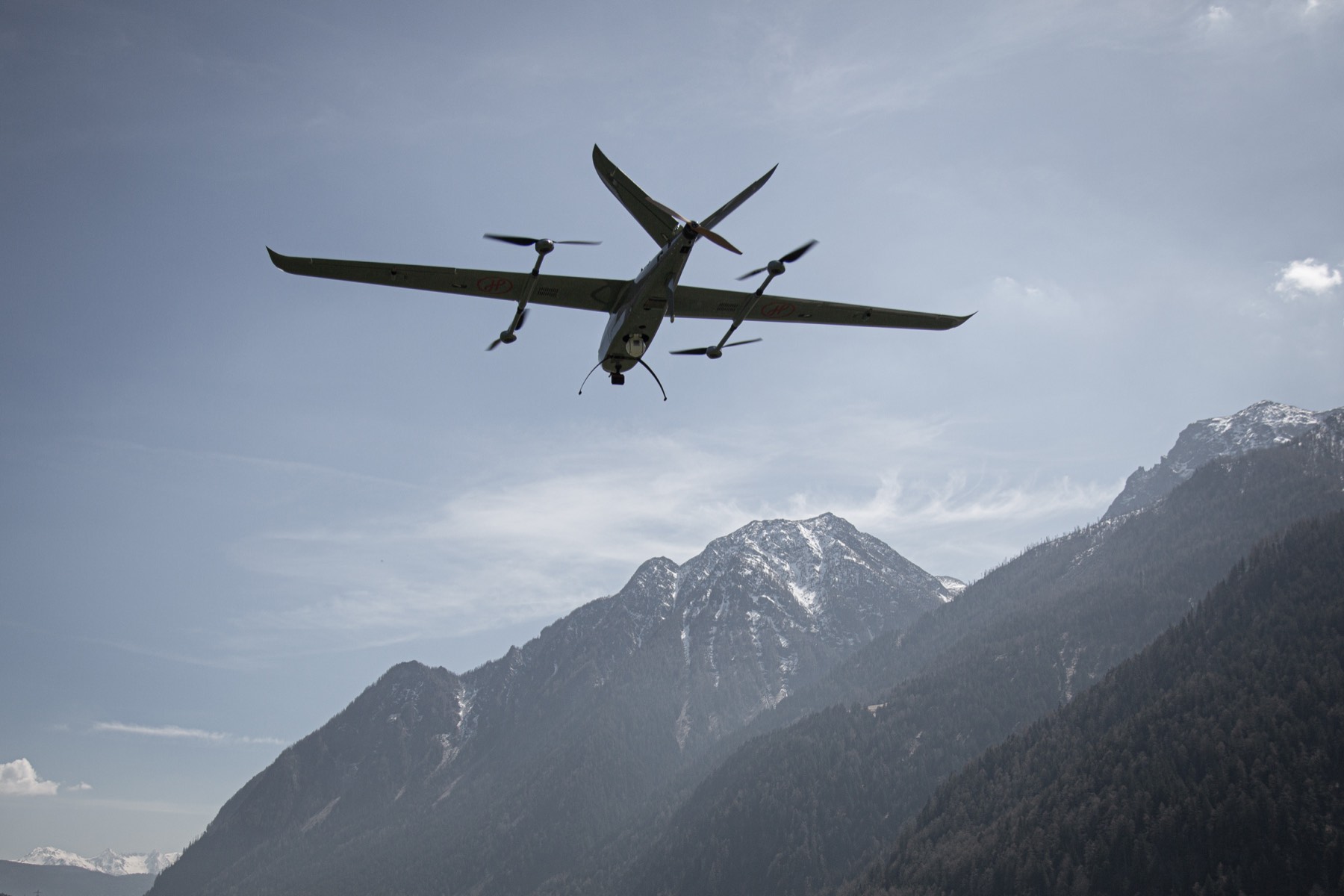
Configure the maritime drone around the vessel, weather and patrol area
Maritime tasks range from coastal monitoring and maritime patrol to offshore asset watch, so the configuration is matched to the launch location, operating radius, endurance and communications coverage. Helvetis selects the platform class for the sea area, stabilised EO/IR and thermal payloads for the contacts and conditions, and satellite connectivity for how far offshore the aircraft will range. Where the mission calls for it, optional AI video analytics add detection and tracking on the live feed, with georeferenced points for reporting.
The system is tested as one capability and handed over with training so your team can launch, fly and recover at sea independently. Indicative figures across the Jabali family appear in the spec table, with final specifications confirmed at configuration and a detailed datasheet available on request. Helvetis supports the capability across its life, drawing on its offshore experience throughout.
Payloads and connectivity at sea
Over water, the payload and the link matter most. Jabali carries stabilised EO/IR with optical zoom and thermal imaging, so it can detect and identify vessels, people in the water, coastlines and offshore assets by day and night, against a moving, low-contrast background. The payload is chosen for the contacts and conditions of the sea area, and specialised sensors can be integrated where the mission needs them.

Distance is the maritime challenge, which is why connectivity is central. Beyond-line-of-sight operation over satellite, including Starlink-compatible links, keeps the aircraft tasked and its video flowing far from shore where cellular and radio reach nothing. The connectivity is configured for how far offshore the mission ranges, so the operator keeps control and the picture even at the edge of a patrol.
Detections and imagery are georeferenced and logged, so a contact at sea has a position that can be passed to vessels or coordination centres. Built on Helvetis offshore operating experience, the capability is configured and supported for the realities of maritime work rather than adapted from a land platform as an afterthought.
Configured for maritime
Payload, endurance and connectivity are matched to your sea area and conditions.
- Endurance
- 3 to 10 h
- Range
- 245 to 850 km
- Payload
- 4 to 10 kg
Final figures confirmed at configuration.
Jabali platform variants


|
Jabali E
Electric
Portable · routine missions |
Jabali EX
Electric
Heavy payload · extended reach |
Jabali X
Hybrid fuel
Long endurance · wide area |
|---|---|---|
| 210 | 240 | 600 |
| 245 | 280 | 850 |
| 4 | 10 | 8 |
| 3.4 | 3.9 | 4.0 |
| 70 | 72 | 85 |
| 110 | 130 | 130 |
| 16 | 28 | 30 |
| 20 | 38 | 45 |
| 3500 | 4500 | 3000 |
| 13 | 13 | 13 |
| -10 to 60 | -10 to 60 | -10 to 60 |
| IP54 | IP54 | IP54 |
| Waterproof | Heated, waterproof | Heated, waterproof |
| 3378 × 1500 × 500 | 3914 × 1937 × 712 | 4000 × 2056 × 767 |
Final specifications depend on payload, conditions and configuration.
Questions
Yes.
Jabali supports coastal and offshore monitoring, covering large areas of open water that are costly to watch from the surface. It launches vertically from a confined deck or coastal site, then flies long patrols on the wing with day-and-night EO/IR payloads. Helvetis draws on demanding offshore operating experience to configure and support these missions.
Because it takes off and lands vertically, Jabali needs no deck runway or recovery rig, which makes operating from a confined vessel deck or a constrained coast practical.
It then transitions to efficient wing-borne flight for long over-water patrols. Exact operating limits depend on the platform, sea state and weather.
Configured for maritime work, Jabali observes vessels, coastlines and offshore assets with stabilised EO/IR and thermal payloads, day and night.
Satellite connectivity keeps it tasked and its data flowing far offshore. The right payload and connectivity mix is defined with you and confirmed for the sea area and conditions.
Yes.
Because it takes off and lands vertically, Jabali needs no deck runway or recovery rig, which makes operating from the confined deck of a ship practical, as well as from a coastal site. It then transitions to efficient wing-borne flight for long over-water patrols. Exact operating limits depend on the platform, vessel, sea state and weather, and are confirmed for your configuration.
That depends on the platform, payload and connectivity.
Hybrid platforms reach an indicative range of up to 850 km and endurance of up to 10 hours, and beyond-line-of-sight operation over satellite links, including Starlink-compatible connectivity, keeps the aircraft tasked and its video flowing far from shore where cellular and radio are absent. The practical patrol radius is confirmed for your configuration, sea area and local regulations.
Fixed-wing VTOL aircraft are designed to operate in wind and challenging weather, but the exact limits depend on the platform, the payload and the launch and recovery point, whether that is a deck or a coastal site.
Sea state, wind and visibility all affect what is achievable, so operating limits are defined and confirmed for your configuration, drawing on Helvetis offshore experience.
Jabali systems start from USD 80,000 ready to fly, ex works and before shipping, taxes and training.
For maritime and coastal patrols, the final price depends on the variant, the EO/IR payload, the datalinks and the quantity, so every enquiry receives a written quotation matched to the mission.