

Search and rescue drone: thermal, fixed-wing VTOL, on scene in minutes
Last updated: 18 November 2026
Jabali is a fixed-wing VTOL search and rescue drone with thermal and EO/IR payloads for rapid, wide-area search. It deploys in minutes from a roadside, clearing or vessel, with no runway or launcher, flies efficient search patterns on the wing, and streams live video and geolocated detections to incident command.
Every Jabali is supplied and integrated by Helvetis and configured around your search area and operating tempo.
Capabilities
01
Rapid deployment
Vertical take-off with no runway or launcher means a small team can be airborne and searching within minutes of arriving on scene, launching from a roadside, clearing, deck or vessel.
02
Thermal drones for search and rescue
Thermal imaging reveals heat signatures by day or night, while long endurance supports parallel-track, expanding-square and other wide-area search patterns in a single flight.
03
Live, shareable picture
Real-time video and telemetry reach the ground station and command, so coordinators and field teams see what the aircraft sees and can direct the response as it unfolds.
04
AI-assisted detection
AI-assisted detection can highlight possible people and objects of interest in the live feed to shorten the time to find. The operator confirms every detection and stays in command.
Deploy a search and rescue drone without a runway
In search and rescue the first hours matter most, and the two things that decide outcomes are how fast a team can start searching and how much ground it can cover. Multirotor drones launch anywhere but cover little area before their batteries are spent, and crewed aircraft are powerful but slow and costly to mobilise. A fixed-wing VTOL drone is built for exactly this gap: it lifts off vertically from wherever the team arrives, then transitions to efficient wing-borne flight to sweep a wide search area, returning to a precise vertical landing to swap payloads or batteries and go again.

That combination turns a single crew into a wide-area search asset. Instead of gridding a small box by hand, the team flies long, planned passes with thermal and EO/IR sensors, streaming the picture back to coordinators in real time. AI-assisted detection can flag possible people for the operator to confirm, so the crew spends its attention on decisions rather than on staring at a feed, shortening the time from launch to first sighting.
Why use a fixed-wing VTOL search and rescue drone?
In search and rescue, time and coverage decide outcomes. Multirotor drones launch anywhere but run out of endurance before a large area is covered, while conventional fixed-wing aircraft cover ground but need a prepared runway or launcher. A fixed-wing VTOL drone like Jabali launches vertically from a roadside, clearing or vessel, then flies long and far on the wing, so a single crew can search a wide area quickly with thermal and EO/IR payloads and live AI-assisted detection.
Because it is delivered as an operating capability, the crew gets more than an aircraft: the thermal payload, endurance and connectivity are matched to the search area and tempo, and Helvetis provides the training, software and support to run it. A human stays in command of every AI-assisted decision, which keeps responsibility for each sighting and tasking with the rescue team.
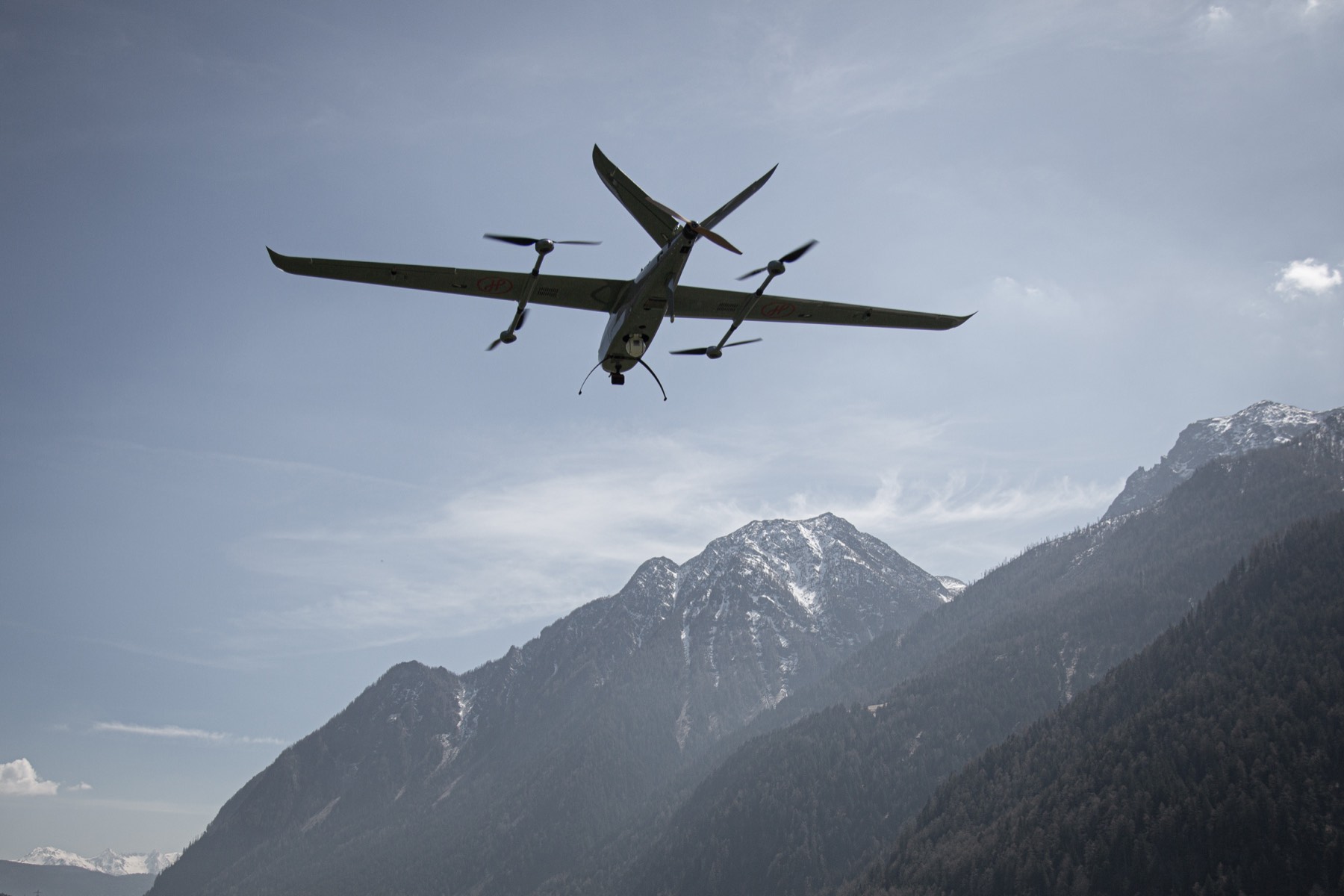
Configure the drone for the search area and response plan
Search and rescue spans very different environments, from alpine terrain and forests to open water and disaster zones, so the configuration is matched to the terrain, search area, weather and command workflow. Helvetis selects the platform class for the endurance and area you need to cover, the thermal and EO/IR payload for the conditions, and the connectivity for how far the search will range from the crew. Optional AI video analytics add detection and tracking on the live feed, with georeferenced points so a sighting can be handed to ground teams quickly.
The system is tested as one capability and handed over with training so your team can run it under pressure. Indicative figures across the Jabali family appear in the spec table, with final specifications confirmed at configuration and a detailed datasheet available on request. Helvetis supports the capability across its life, so it is ready when the next callout comes.
Thermal cameras, live video and geolocated detections
Search and rescue lives or dies on detection, so the payload matters most. Jabali carries thermal imaging to reveal body heat in darkness, undergrowth and poor visibility, alongside stabilised EO/IR with optical zoom for daylight detail and confirmation. To a thermal camera, a person at night reads like a lit match in a dark room. The thermal and optical mix is chosen for the terrain and conditions of the search, and specialised sensors can be added where a mission calls for them.

The live picture is shared as it is captured. Real-time video and telemetry reach the ground station, the coordinator and field teams, so a possible sighting can be confirmed and acted on without delay. Optional AI-assisted detection scans the feed for people and objects of interest and flags them for the operator, which keeps a tired crew effective across a long search and shortens the time from launch to first contact.
Every detection is georeferenced, so once a person is spotted the location can be passed straight to ground or air rescue. Imagery and tracks are logged for the debrief and the record. The aim is simple: more area searched, faster confirmation, and a clear hand-off to the teams who carry out the rescue.
Configured for SAR
Thermal payload, endurance and connectivity are matched to your search area and tempo.
- Endurance
- 3 to 10 h
- Range
- 245 to 850 km
- Payload
- 4 to 10 kg
Final figures confirmed at configuration.
Jabali platform variants


|
Jabali E
Electric
Portable · routine missions |
Jabali EX
Electric
Heavy payload · extended reach |
Jabali X
Hybrid fuel
Long endurance · wide area |
|---|---|---|
| 210 | 240 | 600 |
| 245 | 280 | 850 |
| 4 | 10 | 8 |
| 3.4 | 3.9 | 4.0 |
| 70 | 72 | 85 |
| 110 | 130 | 130 |
| 16 | 28 | 30 |
| 20 | 38 | 45 |
| 3500 | 4500 | 3000 |
| 13 | 13 | 13 |
| -10 to 60 | -10 to 60 | -10 to 60 |
| IP54 | IP54 | IP54 |
| Waterproof | Heated, waterproof | Heated, waterproof |
| 3378 × 1500 × 500 | 3914 × 1937 × 712 | 4000 × 2056 × 767 |
Final specifications depend on payload, conditions and configuration.
Questions
Search and rescue drones fly planned search patterns with thermal and optical cameras, stream live video to incident command and geolocate possible detections.
A fixed-wing VTOL drone like Jabali adds wide-area endurance while keeping vertical take-off from roadsides, clearings or vessels, and AI-assisted detection can highlight possible people, with the operator confirming every detection.
Yes, within the limits of the payload and conditions.
Thermal imaging reveals heat signatures in darkness, smoke and poor light, while stabilised EO/IR with optical zoom confirms a detection when visibility allows. Altitude, weather, vegetation and how exposed the person is all affect performance, and the operator confirms every AI-assisted detection.
Because it takes off and lands vertically with no runway or launcher, a small team can be airborne within minutes of reaching the scene, launching from a roadside, clearing or vessel.
It then transitions to efficient wing-borne flight to search a wide area, so coverage starts fast and continues for hours on a single sortie.
Yes.
Because it launches and recovers vertically, Jabali can operate from a confined deck or a coastal site and then fly long patrols over water, searching with thermal and EO/IR payloads. It supports maritime search and rescue alongside land operations, drawing on Helvetis offshore operating experience. Exact capability depends on the platform, sea state and weather, and is confirmed for your configuration.
Every Jabali is delivered with operator and maintainer training, documentation and support, so a small team can plan, fly and maintain it safely and independently.
Training combines classroom, practical and simulator work, and Helvetis supports acceptance, handover and live operations. The goal is a rescue team that can deploy the capability on its own, within its governing rules, whenever it is needed.
Range depends on the platform, payload, weather and required reserves.
Jabali spans portable electric systems to a hybrid platform with an indicative range of up to 850 km and endurance of up to 10 hours, so a single crew can search a large area or a long coastline on one sortie, then land vertically to swap batteries and continue. The practical search radius is confirmed during configuration.
The best platform depends on the search area.
Multirotors suit close searches and hovering over a point; fixed-wing VTOL drones suit large areas, long coastlines and difficult terrain where endurance and runway-free deployment matter. Payload quality, communications, training and procedures matter as much as the airframe, which is why Jabali is delivered as a configured capability rather than hardware alone.
Jabali systems start from USD 80,000 ready to fly, ex works and before shipping, taxes and training.
For search and rescue, the final price depends on the variant, the thermal payload, the datalinks and the quantity, so every enquiry receives a written quotation matched to the mission.